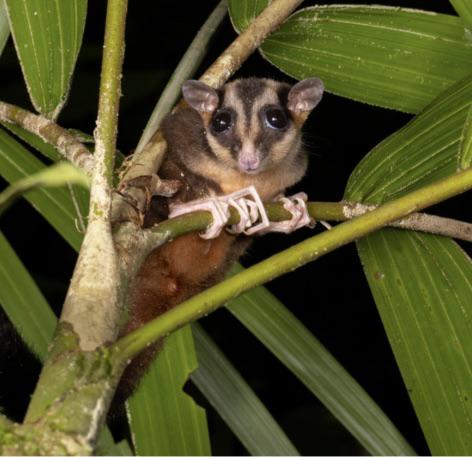
Good News! Two marsupials previously thought to be extinct for 6,000 years have been recently discovered in what was called “a once-in-a-lifetime discovery.”
The Pygmy Long-Fingered Possum and the Ring-Tailed Glider are the two newest members of a very exclusive group of animals after being confirmed to still exist as “living fossils.”
There are only a relatively small number of animals that hold the distinction of being described initially from fossil remains and then discovered as living, according to the authors of a paper depicting this incredible discovery.
“In paleontology,” the paper’s introduction said, “lineages that drop out of the fossil record and then re-emerge after long periods are termed ‘Lazarus taxa.’”
New Guinea is famously underexplored. Its more secretive life-forms are also famously undocumented. Researchers felt greater surveys would eventually reveal the existence of animals.
A photographer named Carlos Bocos recently captured a long-fingered possum in a tree, but that alone wasn’t enough evidence since there are two other species of long-fingered possums.
“The findings underscore the critical importance of preserving these unique bioregions and the value of collaborative research in uncovering and protecting hidden biodiversity,” said Professor Tim Flannery, the lead author of the paper.
The Pygmy Long-Fingered Possum is boldly stripped with freakishly-elongated third digits they use to feel around for wood boring insects.
The species appeared to have vanished from Australia during the Ice Age.
The Ring-Tailed Glider is the nearest living relative of the Australian Greater Glider. In Flannery’s paper and Bocos’ photographs, experts were able to determine that the animal isn’t only a separate species, but a separate genus as well. It is the first new genus of New Guinean mammal documented since 1937. The glider holds deep cultural significance for local communities of the region.
The research was supported by The Global Wildlife Fund and raises new questions about species survival, extinction and the hidden biodiversity that potentially exist in remote forests. This underscores the importance of protecting ancient habitats.